Steel Legends: The Giant Robots That Rewired American Pop Culture Forever
There's something primal about a giant robot. Maybe it's the scale — the sheer audacity of a machine tall enough to step over a skyscraper. Maybe it's the fantasy of sitting in that cockpit, hands on the controls, feeling invincible. Whatever the reason, certain mech designs don't just entertain American audiences — they embed themselves. They show up on lunchboxes, Halloween costumes, tattoo sleeves, and tearful convention panels decades after their debut.
At Robo Murito, we live for exactly that kind of steel-plated legacy. So we put together this ranked countdown of the ten most culturally significant mech designs to ever capture the American imagination. We're talking visual impact, mechanical memorability, and that hard-to-define emotional punch that makes a robot feel like more than just a fictional vehicle.
Buckle up. This one's for the fans who grew up with their eyes wide open.
10. Gigantor — The Grandfather Nobody Forgets
Before Voltron. Before Optimus. Before any of it, there was Tetsujin 28-go, rechristened Gigantor for American TV in the 1960s. Boxy, lumbering, and controlled by a kid with a remote — Gigantor wasn't sleek, but he was first. For a generation of American kids who'd never heard the word "anime," Gigantor was proof that robots could be heroes. The design's simplicity is almost charming by modern standards, but its cultural footprint is undeniable.
9. Megazord (Mighty Morphin Power Rangers) — The Schoolyard Argument Settler
Ask any American kid who grew up in the early '90s what the coolest robot was, and a huge chunk of them will say Megazord without blinking. The beauty of this design was its modularity — five individual Zords combining into one massive warrior. That combining mechanic became a playground obsession. The Megazord wasn't just a mech; it was a ritual. Watching those dinosaur machines lock together was genuinely thrilling television, and the chunky, primary-colored aesthetic became synonymous with after-school excitement.
8. Evangelion Unit-01 — The One That Made Things Weird (In the Best Way)
NGE's Unit-01 hit American shores through Cartoon Network's Toonami block and immediately broke people's brains — in a good way. Purple, asymmetrical, and disturbingly organic beneath its armor, Unit-01 looked unlike anything Western audiences had seen in a mech. It felt dangerous and alive. The design carried psychological weight that matched the show's themes perfectly, and it introduced a generation of US fans to the idea that giant robots could be horror, not just power fantasy.
7. Optimus Prime (G1) — The Blue-Collar Icon
Technically a Transformer rather than a traditional mech, G1 Optimus Prime deserves his spot here because no other robot design has achieved the same level of cultural saturation in America. The flat-nosed semi-truck cab that folds into a heroic, broad-shouldered warrior became the template for what a robot leader should look like. Optimus wasn't just cool — he was noble. That red-and-blue paint job became shorthand for heroism itself.
6. Gurren Lagann — The Hotblooded Heart Attack
When Gurren Lagann landed on American streaming services, it didn't walk in — it exploded through the door wearing sunglasses. The drill-obsessed, ever-evolving mech from Gainax grabbed US anime fans by the collar and refused to let go. What made the design iconic was its growth — Gurren Lagann literally got bigger and more absurd as the show went on, culminating in galaxy-scale insanity. It became a symbol of maximalist ambition, and American fans absolutely ate it up.
5. Gypsy Danger (Pacific Rim) — Hollywood Finally Got It Right
For years, American-made giant robot movies ranged from underwhelming to outright embarrassing. Then Guillermo del Toro delivered Pacific Rim in 2013, and Gypsy Danger became the mech design that proved Hollywood could play in this sandbox respectfully. Inspired by classic kaiju-era aesthetics but filtered through a modern blockbuster lens, Gypsy Danger had weight — you felt every punch it threw. The analog-era design details (like the physical turbine in its chest) gave it a blue-collar, working-class dignity that resonated strongly with American audiences.
4. RX-78-2 Gundam — The Blueprint
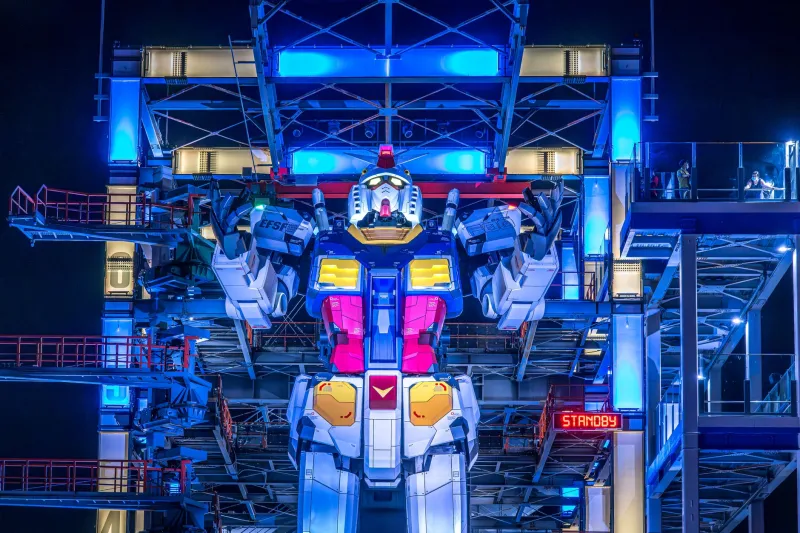
The original Gundam might not be the flashiest design on this list, but it's arguably the most influential. The tricolor scheme, the V-fin antenna, the beam rifle — every "realistic" mecha design that followed owes something to Yoshiyuki Tomino's foundational work. American fans discovered Gundam through model kits (Gunpla culture exploded in the US), and the RX-78-2 became the face of that obsession. It's the mech that taught US audiences to take giant robots seriously as engineering rather than just fantasy.
3. Voltron — The Defender of Saturday Mornings
Voltron: Defender of the Universe was the after-school appointment in the mid-1980s. Five robot lions combining into a single, sword-wielding warrior was pure genius, and the design communicated heroism through sheer visual confidence. That black lion forming the body, the blazing sword materializing from thin air — it was theatrical in a way that felt genuinely epic to young American viewers. The Netflix reboot proved the legacy had staying power, introducing a slicker version to a new generation while the original design remained a collector's grail.
2. Mazinger Z — The Ancestor That Shaped Everything
Few Western fans outside hardcore circles know Mazinger Z by name, but they know its DNA. Go Nagai's 1972 creation established the piloted mech template that basically every entry on this list descends from. The concept of a human pilot inside the robot — rather than remote-controlling it — was revolutionary, and Mazinger's angular, imposing design set visual conventions that lasted decades. As US fans dig deeper into mecha history, Mazinger Z keeps getting rediscovered and celebrated, cementing its retroactive cultural status.
1. The Jaeger Concept (Pacific Rim) + Voltron Legacy — A Tie for the Soul
Okay, we're cheating slightly at number one — but hear us out. If you ask what single idea most defines American mech culture, it's the fusion of Voltron's combining-team mythology and Pacific Rim's grounded, cinematic execution. Together, these two represent the full arc of giant robot fandom in America: the wide-eyed cartoon era that built the emotional foundation, and the prestige blockbuster moment that validated the obsession for mainstream audiences. One gave us the dream. The other made it feel real.
Why These Designs Still Matter
Mech design isn't just aesthetic — it's storytelling. The shapes, colors, and mechanics of these machines communicate personality, power, and purpose before a single line of dialogue is spoken. That's why American fans connect so deeply with these steel giants across generations. Whether you're a kid watching Voltron on a Saturday morning in 1985 or a college student streaming Neon Genesis Evangelion at 2 a.m. for the first time, the right mech design hits somewhere fundamental.
At Robo Murito, we think that's worth celebrating loudly and often. These aren't just fictional machines — they're cultural landmarks. And the best part? The list keeps growing. Somewhere out there, the next iconic mech is already being drawn on a storyboard.
We can't wait to add it to the countdown.